This project was about creating a prototyping website for the campaign, which aims to inform viewers:
In the near future, space junk is expected to pose a great threat to mankind. We would like to explore ways to prevent or slow the problem before it happens.

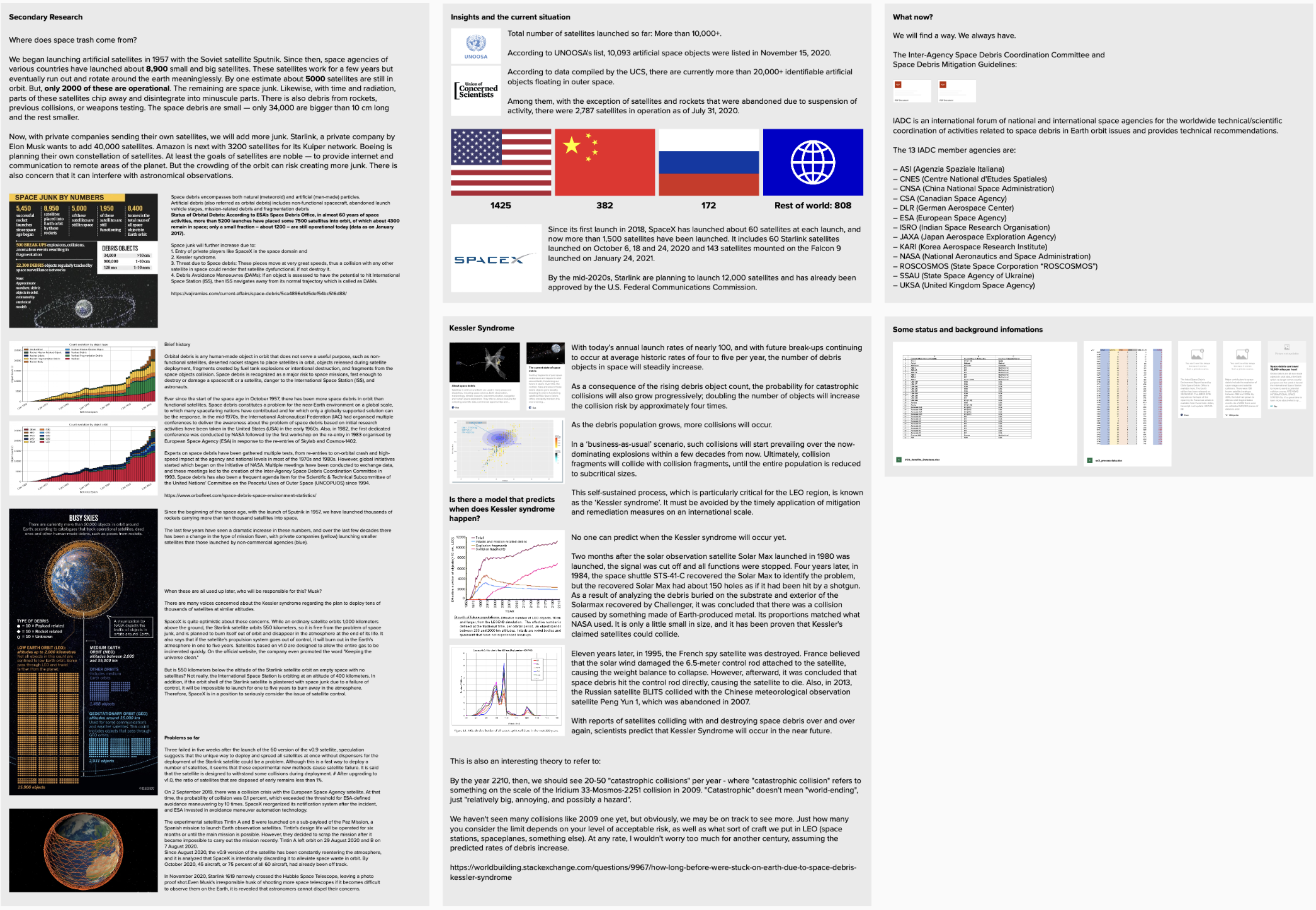
Before proceeding with the project, a lot of research has been done: The current amount of space debris. A regression model of Kessler syndrome to show some predictions of how and when would it happen if the space debris keep accumulating at this pace and etc. you can check out the details below the link:
This website introduces Takenobu Igarashi's some of the best artwork collections. Various mediums of aluminum, metal, and painting were used.
The credits of those artwork below goes to the author, Takenobu Igarashi.
"Soviet fires Earth satellite into space.
It is circling the globe at 18,000 M. P. H.
Sphere tracked in 4 crossings over U. S."
- New York Times, October 5, 1957
October 4, 1957, 19:29:34 UTC,
Baikonur Space Station.
The Soviet Union launched Sputnik 1,
mankind's first satellite.
January 4, 1958.
After flying about 6,000,000 km,
Sputnik 1 entered Earth's atmosphere and burned away.
Since than,
the advance into space is always one of mankind's greatest challenges.
However,
ironically,
this great challenge of mankind could make us no longer go into space.

Once a satellite lands in orbit around Earth,
it is trapped in orbit,
and wandering around Earth.
Forever.
What if they collide or bump into each other?
THE FIRST
COLLISION

Cerise satellite hit by a catalogs
debris object, leftover from an Ariane rocket launched in 1986. It left the Cerise satellite severely damaged.
This was the first verified collision between two artificial objects in space.

The derelict Kosmos 2251 satellite, launched 1993 and operational iridium 22 satellite, lanched 1997 collided with a relative speed of 11.7km/s, creating thousands of debris fragments.
It makes countless debris from the size of a small coffee bean to a computer monitor.
Those debris travel at about 40,000 km/h,
meaning a collision with a coffee bean size fragment can create
more than 10 times as much energy as a bullet.
Space Debris Producing Events from 1965 to 2019

And sometimes,
those fragments fall to Earth.
Count Evolution of the Satellite Launches.
It shows how the number of satellites raised fast historically in an impactful way by showing the dots surrounding the earth increased rapidly.